The Drug Discovery Maze: Where AI Steps In
Enterprise ai drug discovery software for pharmaceutical companies in the usa – Think about the traditional drug discovery process for a moment. It’s a bit like searching for a needle in a haystack, except the haystack is enormous, and there are countless needles that look promising but turn out to be duds. Researchers spend years, literally years, sifting through mountains of data, testing countless compounds, and trying to understand complex biological pathways. It’s incredibly labor-intensive, prone to human error, and, as I mentioned, super expensive.
This is precisely where AI really shines. Artificial intelligence, particularly machine learning and deep learning, can process and analyze data at a scale and speed that no human team ever could. We’re talking about identifying potential drug targets, predicting how compounds will interact with biological systems, and even designing novel molecules from scratch. It’s not magic, but it certainly feels like it sometimes. For me, the biggest draw is its ability to find patterns and make predictions that might be completely invisible to the human eye, simply because of the sheer volume of information involved. It helps us narrow down that haystack, making the search for that elusive needle much more targeted and efficient.
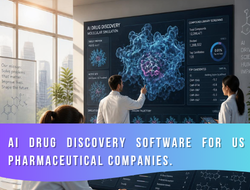
From Lab Bench to Laptop: How AI Transforms Each Stage
When we talk about enterprise ai drug discovery software, we’re not just talking about one single tool. It’s actually a suite of sophisticated applications designed to integrate into various stages of the drug development pipeline. Each stage, from the very beginning to preclinical trials, can see significant benefits.
Identifying Promising Targets with Unprecedented Speed
Finding the right biological target is, in my opinion, one of the most critical steps. If you pick the wrong target, everything else falls apart. Traditionally, this involves extensive literature reviews, genomic studies, and a lot of trial and error. It’s slow. AI, however, can analyze vast datasets – genomics, proteomics, patient data, scientific literature – to pinpoint disease-causing proteins or pathways with remarkable accuracy. It can even suggest novel targets that researchers might not have considered. This means less wasted effort and a much stronger foundation for the entire project.
Designing and Optimizing Molecules: A New Era of Precision
Once a target is identified, the next big challenge is finding or designing a molecule that can effectively interact with it. This is where AI really gets exciting.
Virtual Screening and Lead Optimization
Imagine sifting through billions of potential chemical compounds. That’s what virtual screening does, but AI makes it incredibly fast. Instead of synthesizing and testing every single compound in a lab, AI models can predict how well a compound will bind to a target, its toxicity, and its pharmacokinetic properties (how it moves through the body). This drastically reduces the number of compounds that need to be physically synthesized and tested. Then, for the most promising “lead” compounds, AI can help optimize them, tweaking their structure to improve efficacy, reduce side effects, and enhance stability. It’s like having a super-smart chemist who can run a million experiments in their head in seconds.
I’ve seen examples where AI has helped design molecules with specific properties that were incredibly difficult to achieve through traditional methods. It’s not just about speed; it’s about unlocking new chemical spaces and possibilities. This kind of precision is, frankly, revolutionary for pharmaceutical companies in the USA looking to stay competitive.
Navigating the AI Landscape: Choosing the Right Enterprise Solution
Okay, so the benefits are clear. But how do you actually go about implementing enterprise ai drug discovery software? It’s not a small undertaking, and choosing the right platform is absolutely crucial. This isn’t a one-size-fits-all situation.
Integration and Scalability: Making it Work with What You Have
One of the biggest concerns I hear from pharmaceutical companies is, “How will this fit into our existing infrastructure?” And it’s a valid question. You’ve got legacy systems, established workflows, and a ton of proprietary data. A good AI solution needs to integrate seamlessly. It should be able to ingest data from various sources – your internal databases, public repositories, experimental results – and present it in a unified, actionable way. Scalability is also key. As your research grows, as your data expands, the software needs to grow with you, handling increasing computational demands without skipping a beat. You don’t want to invest in something that’s obsolete in a couple of years.
Data Security and Compliance: Non-Negotiables in Pharma
This one is a no-brainer, but it bears repeating: data security is paramount. Pharmaceutical data, especially patient data and proprietary compound information, is incredibly sensitive. Any ai drug discovery software you consider must have robust security protocols in place, adhering to all relevant regulations like HIPAA and other industry-specific compliance standards. You need to know your intellectual property is safe, and that patient privacy is protected. Frankly, if a vendor can’t demonstrate top-tier security, they’re not worth considering. It’s just too risky.
User Experience and Training: Empowering Your Scientists
Let’s be real, even the most powerful AI software is useless if your scientists can’t figure out how to use it. The user interface needs to be intuitive, even for complex tasks. And, just as important, the vendor should offer comprehensive training and ongoing support. Your researchers are experts in biology and chemistry, not necessarily AI. The goal is to empower them, not overwhelm them. A good enterprise ai drug discovery software should feel like an extension of their capabilities, not a barrier. I think this human element, the ease of use, is often overlooked but is absolutely critical for successful adoption.
The Future is Now: Impact on Pharmaceutical Companies in the USA
The impact of ai drug discovery software on pharmaceutical companies in the USA is already profound, and it’s only going to grow. We’re seeing a shift in how research is conducted, how decisions are made, and even how talent is recruited. Companies that embrace this technology early are likely to gain a significant competitive edge. They’ll be able to bring more drugs to market, and do it faster and more affordably.
Think about the economic implications. Reduced R&D costs mean more resources can be allocated to other critical areas, or even passed on as lower drug prices (one can hope!). Faster drug development means patients get access to life-saving treatments sooner. It’s a win-win, really. I believe this technology isn’t just about efficiency; it’s about accelerating innovation and ultimately improving human health on a global scale. It’s a pretty exciting time to be involved in this field, if you ask me.
FAQ
Q1: Is AI going to replace human scientists in drug discovery?
Absolutely not. I really don’t think so. AI is a tool, a very powerful one, but it’s designed to augment human intelligence, not replace it. Scientists will still be crucial for designing experiments, interpreting results, making critical decisions, and bringing their invaluable intuition and creativity to the table. AI handles the heavy data lifting; humans provide the insight and direction.
Q2: How long does it typically take to implement enterprise AI drug discovery software?
That really varies quite a bit. It depends on the complexity of the software, the size of your organization, and how much integration is needed with existing systems. It could be anywhere from a few months for a more focused solution to over a year for a comprehensive, enterprise-wide deployment. Planning and data preparation are key.
Q3: What kind of data does AI drug discovery software use?
A huge variety! We’re talking about genomic data, proteomic data, chemical compound libraries, clinical trial results, scientific literature, patient records, imaging data, and even real-world evidence. The more diverse and high-quality the data, the better the AI models perform.
Q4: Is AI drug discovery software only for large pharmaceutical companies?
Not necessarily. While large companies might have the resources for the most comprehensive enterprise ai drug discovery software, there are also more modular or cloud-based solutions emerging that can be accessible to smaller biotech firms or even academic research institutions. The barrier to entry is definitely getting lower.
Q5: What are the biggest challenges in adopting AI for drug discovery?
From what I’ve seen, the biggest hurdles often involve data quality and availability, integrating new AI systems with legacy IT infrastructure, and, honestly, getting buy-in and training for your existing scientific staff. It’s a big cultural shift, too.
Q6: How accurate are AI predictions in drug discovery?
The accuracy is constantly improving, but it’s not 100% perfect, and we shouldn’t expect it to be. AI provides probabilities and predictions, which still need to be validated through experimental testing. It significantly increases the likelihood of success and reduces the number of dead ends, but it doesn’t eliminate the need for lab work.
Q7: What’s the ROI for investing in AI drug discovery software?
The return on investment can be substantial, though it’s often realized over the long term. We’re talking about reduced R&D costs, faster time to market, higher success rates for drug candidates, and the ability to discover novel therapies that might have been missed otherwise. These benefits can translate into billions of dollars saved and earned over the lifespan of a successful drug.
Conclusion
So, where does that leave us? Well, I think it’s pretty clear that ai drug discovery software isn’t just a passing trend. It’s a fundamental shift in how we approach one of humanity’s most critical endeavors: finding new medicines. For pharmaceutical companies in the USA, especially those looking to stay at the forefront of innovation, embracing enterprise ai drug discovery software is no longer a luxury; it’s a strategic necessity. It promises to streamline processes, cut down on costs, and, most importantly, accelerate the delivery of life-changing treatments to patients who desperately need them. If you’re in the pharma space, now is definitely the time to seriously explore how these powerful tools can transform your research and development efforts. The future of medicine, in my opinion, is undeniably intertwined with artificial intelligence.