The Old Way vs. The New Way: A Night and Day Difference
Enterprise generative ai drug discovery platform for molecular design usa – For decades, drug discovery followed a pretty standard, albeit arduous, path. You’d start with a target, maybe a protein involved in a disease, and then you’d screen millions of compounds, hoping to find one that binds effectively. It was largely trial and error, a lot of brute force, and honestly, a ton of dead ends. Chemists would spend years synthesizing molecules, testing them, and then going back to the drawing board. It was slow. It was costly. And it often felt like a shot in the dark.
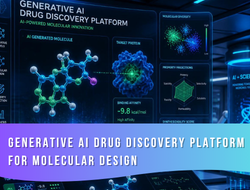
Now, enter generative AI. This isn’t just about analyzing existing data; it’s about creating new data, new possibilities. A generative AI drug discovery platform can learn from vast datasets of known molecules, their properties, and how they interact with biological targets. Then, it doesn’t just pick from a list; it generates novel molecular structures that are predicted to have the desired characteristics. It’s like having an army of brilliant chemists working around the clock, constantly brainstorming and designing new compounds, but at a speed and scale no human team could ever match. It’s a game-changer, plain and simple.
How Generative AI Actually “Thinks” About Molecules
So, how does this magic happen? Well, it’s not really magic, it’s sophisticated algorithms. At its core, generative AI uses models like Generative Adversarial Networks (GANs) or variational autoencoders (VAEs). These models essentially learn the “rules” of chemistry and biology from massive amounts of data. They understand what makes a molecule stable, what makes it bind to a certain protein, or what might make it toxic.
Once it’s learned these rules, the AI can then start to “imagine” new molecules. It’s like giving an artist all the rules of painting – color theory, perspective, composition – and then asking them to create something entirely new. The AI generates a candidate molecule, and then another part of the AI (the “discriminator” in a GAN, for example) evaluates it, saying, “Does this look like a plausible, effective drug candidate?” This feedback loop helps the generative model get better and better at designing molecules that are not only novel but also highly promising. It’s a pretty elegant system, if you ask me.
Beyond Just Generating: Optimizing for Success
It’s not enough to just generate a bunch of new molecules. We need molecules that actually work and are safe. This is where the optimization part comes in, and it’s crucial. A good generative AI drug discovery platform doesn’t just spit out random structures; it optimizes them for specific properties. Maybe you need a molecule that’s highly selective for a particular receptor, or one that has a very specific solubility profile. The AI can be guided to generate molecules that fit these precise criteria.
This targeted approach is a huge leap forward. Instead of synthesizing thousands of compounds hoping one works, we’re synthesizing a much smaller, more focused set of compounds that the AI predicts will have the desired properties. This saves an incredible amount of time, resources, and money. For an enterprise generative AI drug discovery platform for molecular design USA, this optimization capability is really where the rubber meets the road, translating theoretical potential into practical, actionable leads.
The Real-World Impact for Enterprise Drug Discovery in the USA
Let’s be honest, the pharmaceutical industry is incredibly competitive. Companies are constantly looking for an edge, a way to accelerate their pipelines and bring innovative therapies to market faster. This is exactly where an enterprise generative AI drug discovery platform for molecular design USA truly shines. It’s not just about academic curiosity; it’s about tangible business advantages.
Imagine a scenario where a traditional drug discovery project might take 5-7 years just to get to a lead candidate. With generative AI, that timeline could potentially be slashed in half, or even more. This means getting to clinical trials faster, potentially securing patents sooner, and ultimately, helping patients who are waiting for new treatments. It’s a win-win situation, really. The speed and efficiency gains are just too significant to ignore for any serious player in the pharma or biotech space.
Accelerating Lead Identification and Optimization
One of the biggest bottlenecks in traditional drug discovery is the sheer volume of potential molecules. There are literally billions upon billions of possible chemical compounds. Trying to sift through them all manually is just impossible. Generative AI changes this equation entirely. It can rapidly explore this vast chemical space, identifying promising lead compounds much faster than any human team could.
I’ve seen examples where AI has identified novel scaffolds – completely new molecular frameworks – that chemists hadn’t even considered. This isn’t just incremental improvement; it’s often a paradigm shift. Once a lead is identified, the AI can then help optimize it, tweaking its structure to improve potency, reduce off-target effects, or enhance its pharmacokinetic properties. It’s like having a super-smart assistant who can instantly run a million “what if” scenarios for every molecular modification.
Reducing Costs and Mitigating Risks
Drug discovery is notoriously expensive. We’re talking billions of dollars for a single drug to go from concept to market. A huge chunk of that cost comes from failed experiments, compounds that don’t work, or those that show toxicity later in development. By using a generative AI drug discovery platform, companies can significantly reduce these costs. How? By making better predictions earlier on.
If the AI can help design molecules that are more likely to succeed, you’re spending less on synthesizing and testing compounds that are destined to fail. You’re also potentially identifying toxicity issues or poor pharmacokinetic profiles much earlier, before investing heavily in a compound. This proactive approach to risk mitigation is invaluable. It means fewer resources wasted, and a higher probability of success for the compounds that do make it through the pipeline. It’s a smarter way to invest those precious R&D dollars, in my opinion.
The Competitive Edge in a Global Market
For companies operating in the USA, having access to a cutting-edge enterprise generative AI drug discovery platform for molecular design USA isn’t just a nice-to-have; it’s becoming a competitive necessity. The global race for new drugs is intense. Countries and companies worldwide are investing heavily in AI for drug discovery. If you’re not leveraging these tools, you risk falling behind. It’s really that simple. This technology offers a distinct advantage, allowing US-based companies to innovate faster and maintain their leadership in pharmaceutical research and development. It’s about staying ahead of the curve, and frankly, staying relevant.
FAQ
- What exactly is a generative AI drug discovery platform?
It’s a system that uses artificial intelligence, specifically generative models, to design and suggest novel chemical compounds with desired properties for drug development, rather than just screening existing ones. It essentially “creates” new molecular ideas. - How does it differ from traditional drug discovery methods?
Traditional methods rely heavily on high-throughput screening of existing libraries and iterative human-led design. Generative AI, on the other hand, can generate entirely new molecular structures from scratch, guided by specific biological and chemical parameters, significantly speeding up the initial design phase. - Is this technology already being used in the USA?
Absolutely! Many pharmaceutical companies, biotech startups, and academic institutions across the USA are actively implementing or developing enterprise generative AI drug discovery platforms for molecular design. It’s a rapidly growing field. - What kind of drugs can generative AI help discover?
It’s pretty versatile. Generative AI can be applied to discover drugs for a wide range of diseases, including cancer, infectious diseases, neurological disorders, and rare diseases. It’s really about finding molecules that interact with specific biological targets. - Does generative AI replace human scientists in drug discovery?
Not at all. I actually see it as a powerful augmentation. AI handles the massive computational and design tasks, freeing up human scientists to focus on complex experimental validation, strategic decision-making, and applying their deep biological insights. It’s a collaboration, really. - What are the main benefits for an enterprise using this platform?
The big ones are accelerated timelines for lead identification, reduced R&D costs by minimizing failed experiments, improved success rates for drug candidates, and the ability to explore novel chemical spaces that might be missed by human intuition alone. It’s a huge efficiency booster. - Are there any limitations or challenges with generative AI in drug discovery?
Sure, like any new technology. Challenges include ensuring the AI-designed molecules are synthesizable in the lab, accurately predicting complex biological interactions, and integrating these platforms seamlessly into existing R&D workflows. Data quality is also super important for training these models effectively.
Conclusion
So, where does all this leave us? I think it’s pretty clear: generative AI is absolutely transforming how we find new medicines. It’s not just a fancy tool; it’s a fundamental shift that’s making the entire drug discovery process smarter, faster, and more targeted. For any company in the USA serious about innovation in pharmaceuticals, investing in an enterprise generative AI drug discovery platform for molecular design USA isn’t just a good idea; it’s becoming an essential move to stay competitive and, more importantly, to deliver life-changing therapies to patients who desperately need them. We’re really just scratching the surface of what this technology can do, and honestly, I’m incredibly excited to see what breakthroughs it enables in the years to come. If you’re in this space, you really need to be looking at how you can integrate this into your strategy. The future of medicine is here, and it’s powered by AI.